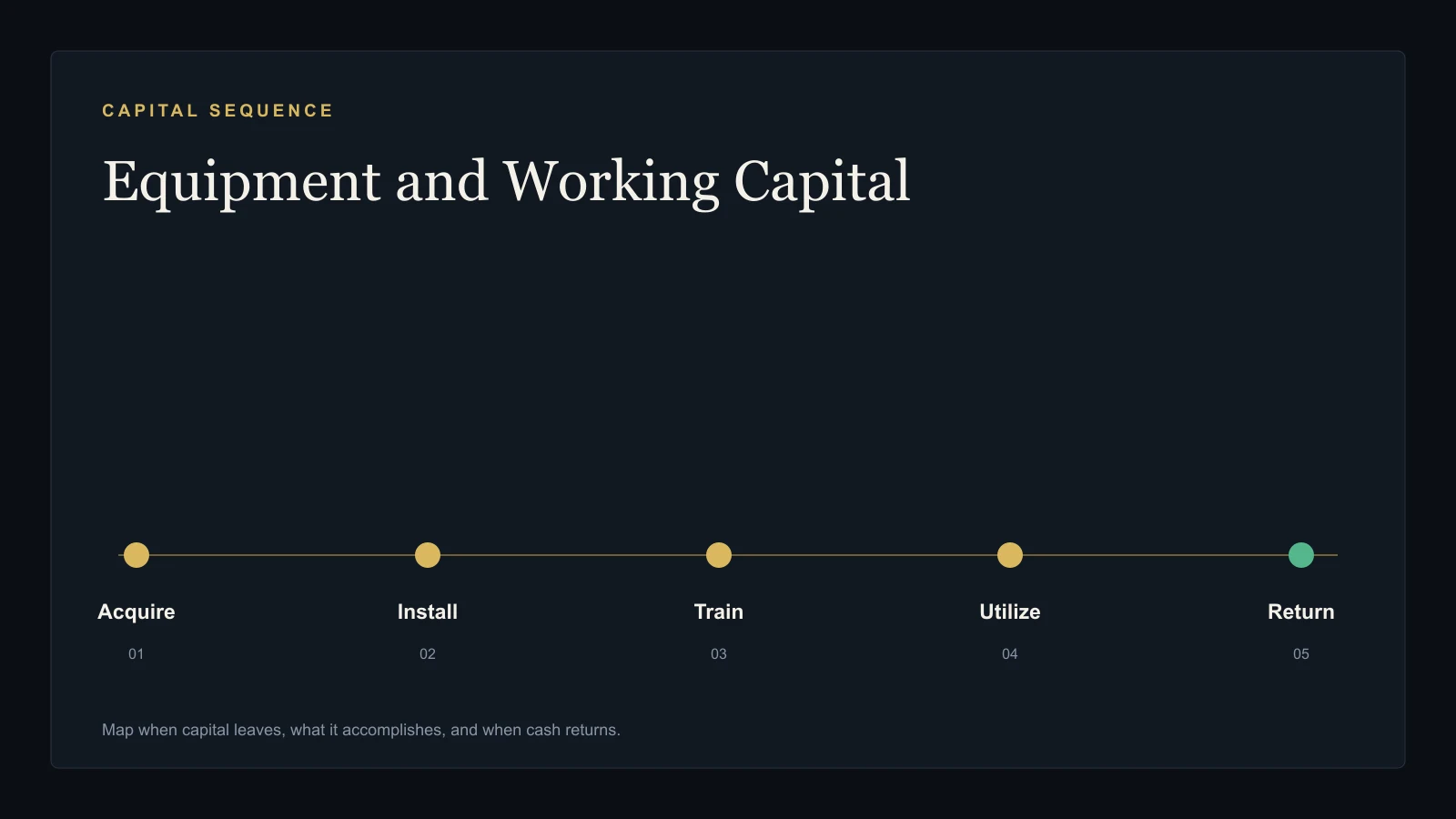
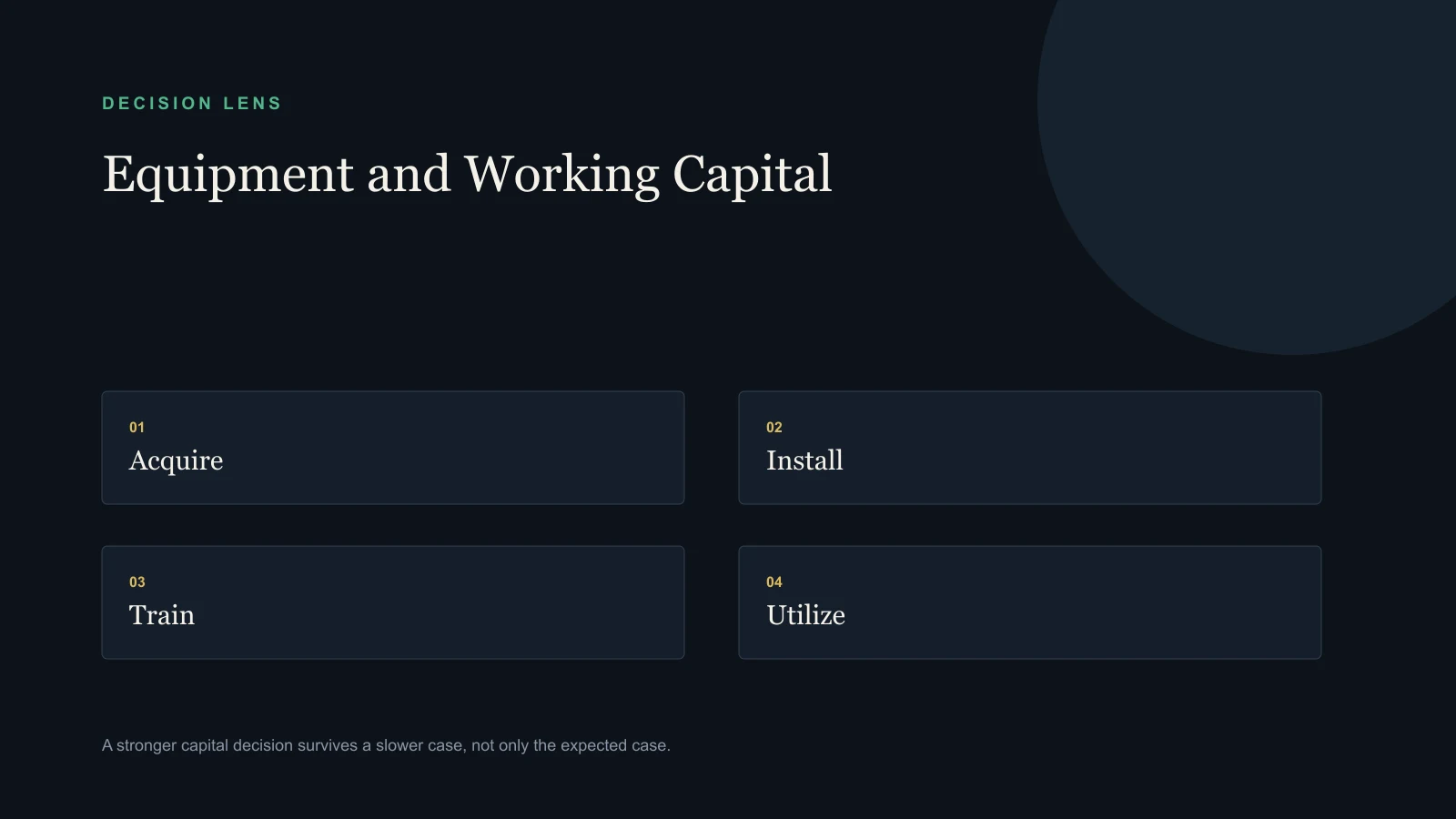
The machine can create capacity before the schedule fills it.
The equipment arrives next month. Payments begin. Training takes time. New work may follow—but utilization rarely jumps to 100% on delivery day.
See the capital decision
Two views of the same operating reality.
Follow the cash sequence, then test the decision against timing, cost, and downside.
Sequence: when cash leaves and when the business expects it to return.Decision lens: the questions that should remain visible before applying.
What revenue or savings must the equipment create—and by when?
Illustrative production expansion
The asset is only one part of the capital requirement.
$1.9M combined plan
Illustration only. These numbers are a planning example, not a financing offer, expected outcome, or qualification threshold.
Equipment acquisition$1,250,000
Installation and training$210,000
Materials and ramp payroll$540,000
Vendor concession-$100,000
01
Finance the asset or the ramp?
An asset-specific structure may be more appropriate for the purchase itself, while working capital may address installation, materials, labor, or transition costs. Compare total cost and duration.
02
Model utilization
Estimate conservative billable hours, throughput, downtime, maintenance, and operator costs. Capacity without demand is not contribution.
03
Protect maintenance liquidity
Preserve enough cash for repairs, insurance, consumables, and the existing operation. A new asset should not leave the business unable to operate it.
Sources and further reading
Capital Ready uses primary institutional sources for general educational context. Product terms and eligibility vary.