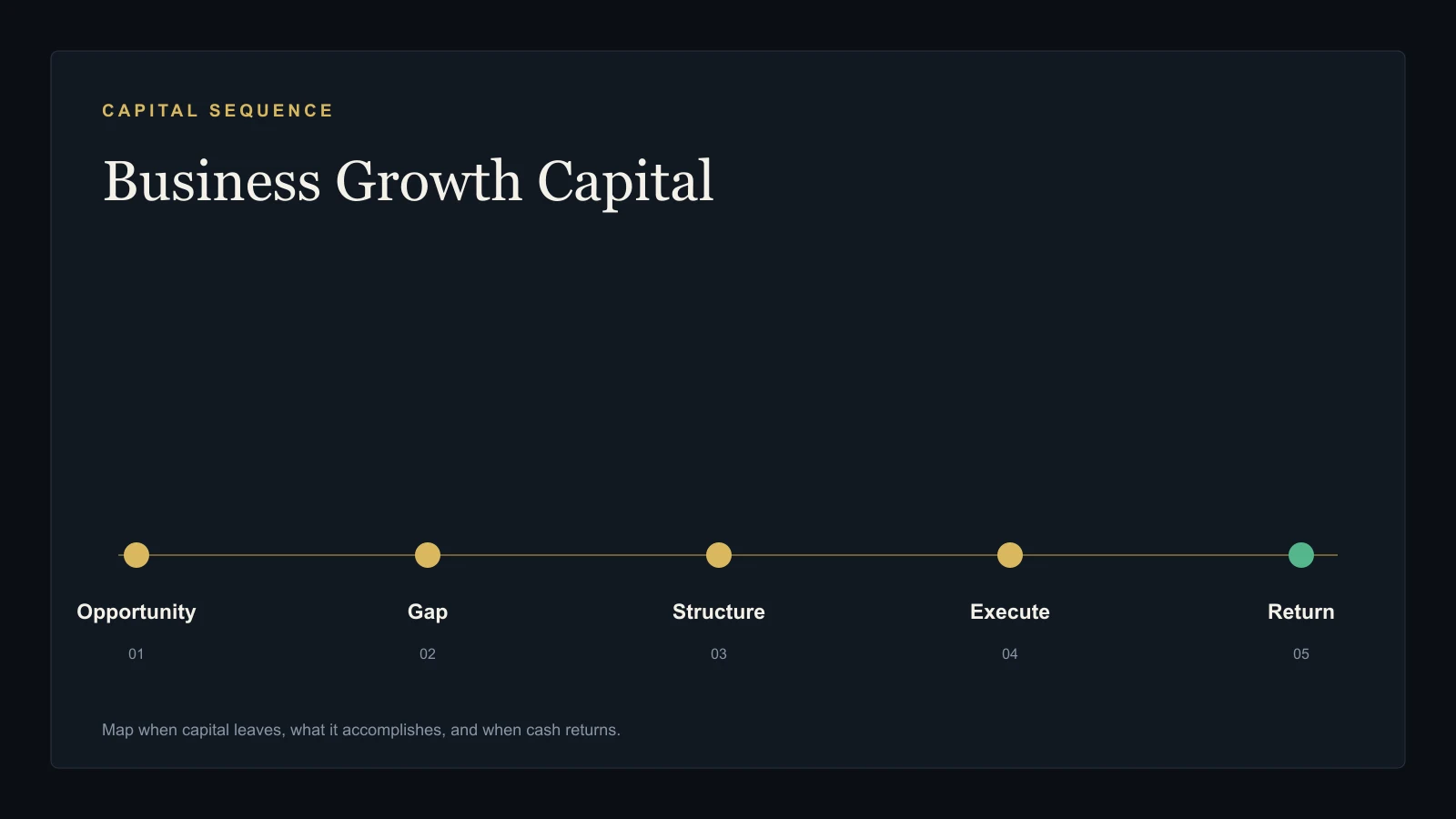
Can the business finance the gap between doing the work and getting paid?
Picture the second crew already working while the first invoice is still 30 days from clearing. Demand is not the only constraint. Growth often asks the bank account to move before revenue catches up.
See the capital decision
Two views of the same operating reality.
Follow the cash sequence, then test the decision against timing, cost, and downside.
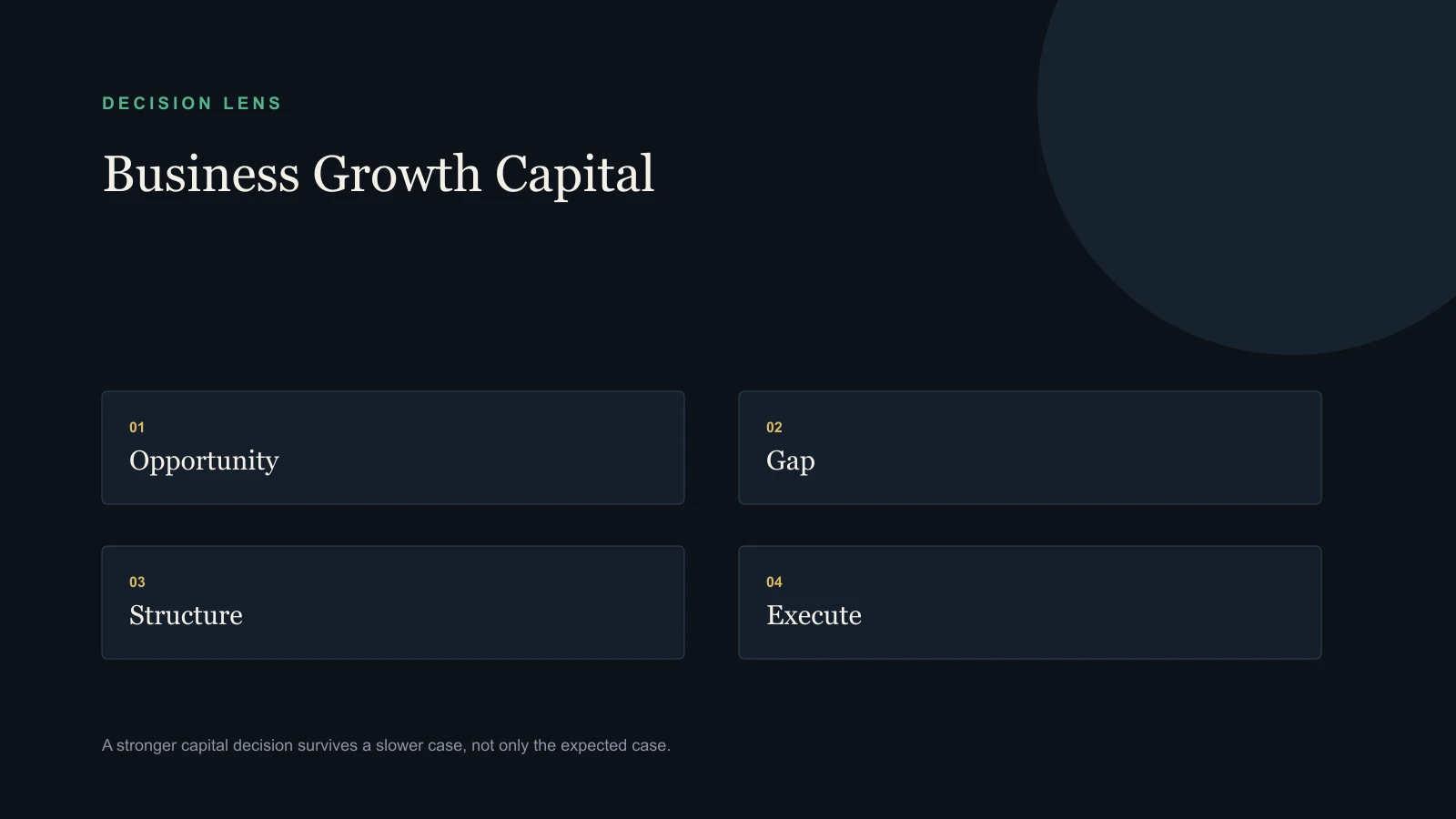
Sequence: when cash leaves and when the business expects it to return.Decision lens: the questions that should remain visible before applying.
If the opportunity works on paper, does it still work after the cost and timing of capital?
Illustrative growth program
A $5M ceiling is not a strategy. A staged use-of-funds plan is.
$3.6M modeled program
Illustration only. These numbers are a planning example, not a financing offer, expected outcome, or qualification threshold.
Contract mobilization$1,400,000
Inventory position$1,050,000
Equipment capacity$850,000
Liquidity reserve$300,000
01
Start with the operating event
Name what changes: another crew, a new location, a larger inventory position, equipment capacity, or contract mobilization. Vague growth creates vague capital requests.
02
Separate revenue from contribution
Incremental revenue is only the top line. Estimate gross margin, subtract additional operating costs not already captured, then subtract a realistic financing-cost assumption entered by you.
03
Future pace the downside too
Ask what must go right, what happens if sales ramp slowly, and which costs remain even when the forecast slips. A serious plan makes room for uncertainty.
Sources and further reading
Capital Ready uses primary institutional sources for general educational context. Product terms and eligibility vary.