
The definitive Capital Ready guide
The Business Owner's Guide to Funding Growth Without Waiting Until It's an Emergency
For the operator who won the work, sees the opportunity, and wants to understand what happens in the bank account before the plan pays off.
Illustrative example
You won the contract. The customer pays last.
Profit and liquidity are not the same thing. A profitable job can require cash weeks before the customer pays.
- Day 1Contract awarded
- Day 3Materials due−$28,000
- Day 7Payroll−$14,000
- Day 14Work begins
- Day 30Invoice submitted
- Day 60–75Customer payment arrives
Inventory cycle
The inventory opportunity exists before the revenue does.
The question is not only whether it will sell. Does the expected margin still make sense after the cost and timing of the capital used to buy it?
- 01Supplier opportunity
- 02Inventory purchase
- 03Inventory arrives
- 04Selling period
- 05Customer purchases
- 06Cash replenishes
Decision framework—not underwriting
Should I use capital for this?
Is there a specific business opportunity or need?
No: Define the use first.
Yes: Continue ↓
What must be paid before the expected inflow?
Map the dated timing gap.
Can existing liquidity comfortably cover it?
Yes: Consider whether outside capital is necessary.
No: Continue ↓
Does expected contribution reasonably exceed estimated cost and risk?
Yes: Compare options.
No: Waiting, reducing scope, or another structure may make more sense.
Why profitable growth creates cash pressure
Growth pulls operating costs forward. Materials, labor, inventory, deposits, and capacity are often paid before the related revenue becomes cash. That does not make every funding decision wise; it explains why profit and liquidity must be planned separately.
The cash conversion cycle
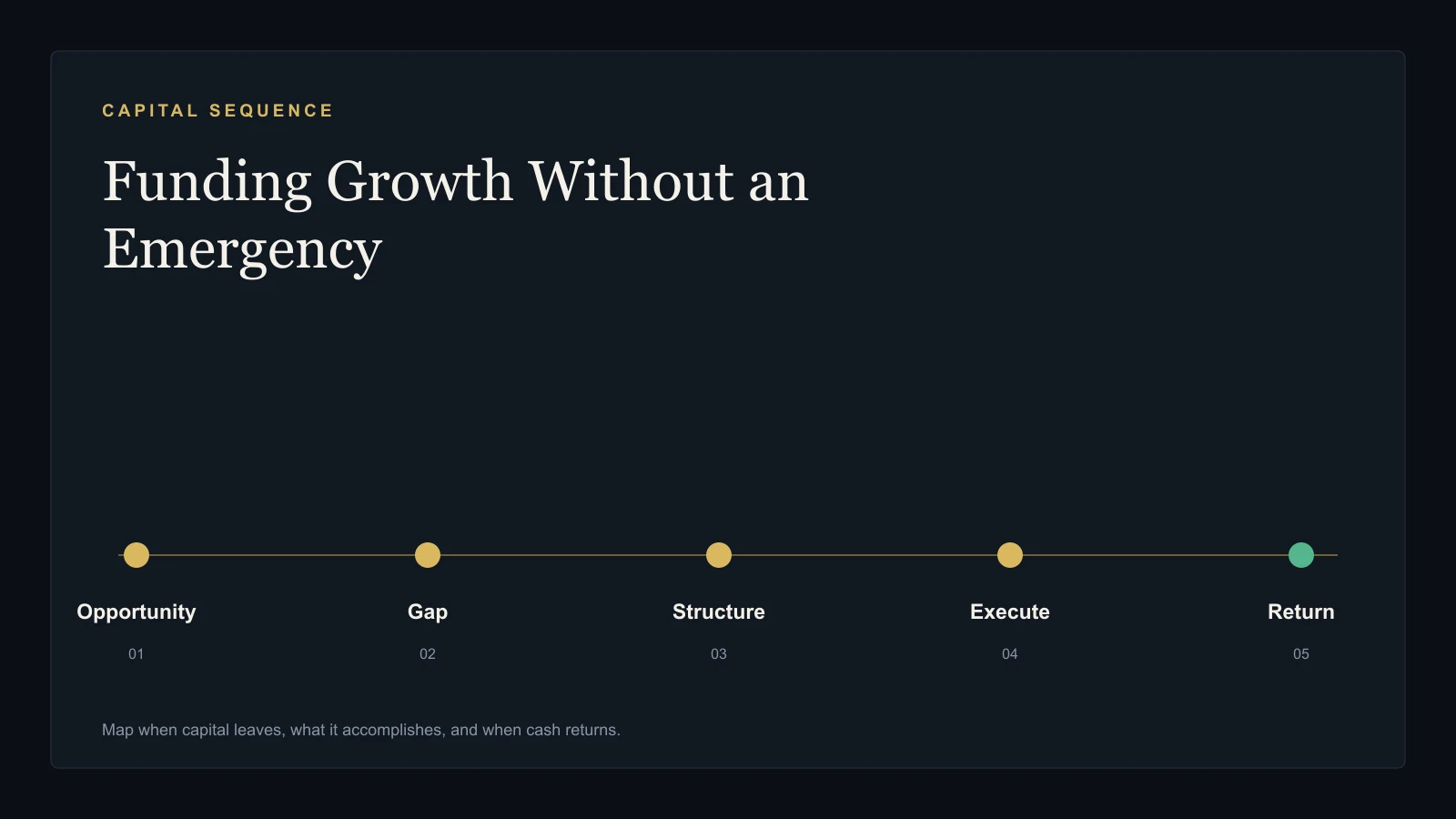
The cycle begins when cash leaves for inventory or performance, continues while work and receivables are outstanding, and ends when customers pay. Shortening any stage—supplier terms, production, invoicing, or collection—can reduce the capital trapped in the cycle.
Contract mobilization
A contract award creates obligation before collection. Date the mobilization costs, performance milestones, invoice approval, payment terms, and possible delays. Calculate the lowest projected cash point, not the headline contract value.
Inventory timing
The inventory opportunity exists before the revenue does. Purchase, freight, arrival, selling period, customer purchase, and cash replenishment form one sequence. Test margin against slower sell-through and carrying risk.
Payroll and receivable timing
Your customer may have 45 days. Payroll does not. Map pay dates against invoice dates and realistic collection dates. A receivable can be valid and still unavailable when employees and vendors must be paid.
Equipment and expansion
Equipment creates capacity; expansion creates future operating leverage. Both can create ramp costs before utilization and break-even. Separate asset financing from the working capital required to install, staff, stock, and operate the new capacity.
Calculating the true working-capital gap
Add relevant outflows before the expected inflow. Subtract responsibly allocated business cash and expected inflows during the same period. The result is an estimated timing gap—not an approval amount or borrowing capacity.
Calculate your timing gap →Cost of capital versus cost of waiting
Compare the expected contribution after financing cost with the value and risk of waiting. Cheaper capital that arrives after the opportunity disappears may not solve the problem; fast capital that overwhelms cash flow may create another.
Test the opportunity economics →Comparing funding structures
Compare purpose fit, total cost, payment frequency, term, collateral or guarantees where applicable, speed, flexibility, and downside. Lines, term loans, equipment financing, SBA-type options, working capital, and revenue-based structures solve different problems.
Compare funding structures →Existing obligations
Model every current business payment alongside a potential new one. The relevant question is not only whether revenue covers payments on average, but how the combined cadence behaves in a slower week or month.
Reading business bank statements
Deposits are not automatically revenue. Ending balance is not average balance. Cash volume, negative activity, overdrafts, transfers, existing payments, and revenue-related deposits each describe different parts of the operating picture.
Preparing six statements
Use the six most recent consecutive business bank statements. Include every page, keep them readable, and redact nothing. Capital Ready never collects them; the secure application is completed through T.A.G. Business Funding.
Check all six statements →How much capital should you request?
Ask for a purpose, not a round number. Build from dated line items, subtract cash and inflows already available, and add only a defensible contingency tied to identifiable uncertainty.
When waiting may be smarter
Waiting, staging, reducing scope, renegotiating terms, or preserving liquidity can be rational when documents are incomplete, economics are weak, obligations are already severe, or the purpose is unclear.
Questions before accepting any offer
What is the total obligation? How and how often are payments made? What is the estimated duration? What happens if revenue slows? Are there fees, guarantees, security interests, reconciliation rights, or prepayment effects? Review the actual agreement and seek qualified legal, tax, or accounting advice when appropriate.